Across industries, organisations face growing pressure to reduce carbon emissions, improve resource efficiency and demonstrate real progress against their Environmental, Social and Governance (ESG) commitments.
While many sustainability strategies focus on energy or transport, one of the most overlooked opportunities lies within the product lifecycle itself: how materials are used, reused and recovered.
Beyond linear: why circularity matters now
For decades, supply chains have largely followed a linear model of manufacture, use and dispose. This approach is resource-intensive and increasingly at odds with both regulatory expectations and customer demands.
A circular model, in which materials stay in use for longer through reuse, refurbishment or remanufacturing, offers a practical alternative. It reduces reliance on virgin materials, minimises waste and, critically, lowers embedded carbon.
However, moving from linear to circular is not simply a sustainability initiative. It requires structural change across the entire value chain, from product design and logistics to partner collaboration and customer engagement.
Turning circularity into measurable impact
One of the biggest challenges organisations face is not just implementing circular practices but demonstrating their impact in a credible and measurable way.
CO₂ reduction must be more than an estimate. It needs to be based on robust, transparent methodologies that stand up to scrutiny.
For example, in toner supply chains, emissions can be significantly reduced by reusing existing materials rather than producing new ones from virgin plastic. When supported by material-level data and recognised conversion factors, organisations can quantify avoided emissions and integrate them into ESG reporting.
This shift from ambition to accountability is essential. Without measurable outcomes, circular initiatives risk being seen as aspirational rather than impactful.
Scaling circularity: the role of collaboration
Delivering circular solutions at scale is not something any single function or organisation can achieve alone. It requires cross-functional alignment, bringing together:
- Logistics and reverse supply chain operations
- Manufacturing and remanufacturing capabilities
- Sustainability and ESG reporting teams
- Commercial and customer-facing functions
In addition, external partners play a critical role in enabling material collection and recovery across different geographies.
When these elements are aligned, organisations can create a joined-up circular ecosystem, where materials flow efficiently and environmental benefits are maximised.
A practical example of circularity in action
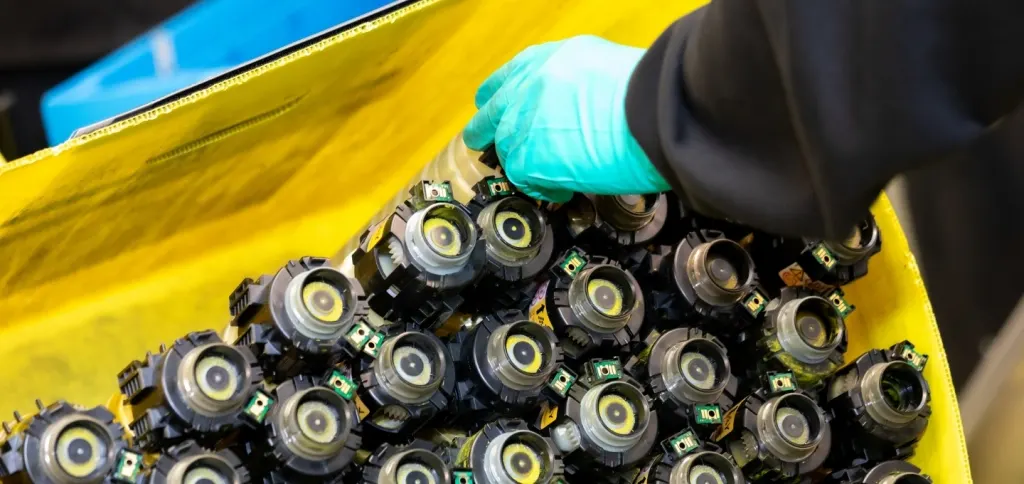
Within RICOH Europe and across the EMEA region, this approach has been applied to toner bottle reuse, turning what was once a single-use product into part of a circular supply chain.
Used bottles are collected, cleaned, refilled and returned to the market, maintaining the same performance standards as new products while reducing environmental impact.
The results illustrate how circularity can scale when supported by the right structure:
- Since 2021, over 2.2 million toner bottles have been reused
- CO₂ savings have grown from around 113 tonnes in FY22 to around 643 tonnes in FY25
These outcomes are not just operational achievements. They demonstrate how circular models can deliver measurable ESG value, both for organisations and their customers.
Why this matters for customers
For many organisations, sustainability is no longer a differentiator: it is a requirement.
Customers increasingly look for solutions that can:
- Reduce their carbon footprint
- Support ESG reporting and regulatory compliance
- Align with green procurement standards
Circular supply chains provide a way to achieve this without compromising on product performance or reliability.
Looking ahead: from progress to scale
The next challenge is scaling these models further. Future developments will need to focus on:
- Expanding participation in collection and recovery programmes
- Enhancing CO₂ accounting, including the impact of reverse logistics
- Communicating sustainability outcomes through clear, relatable metrics
For example, planned activity at RICOH's Telford-based manufacturing site alone includes reuse of over 587,000 toner bottles in FY26, with projected CO₂ savings of approximately 412 tonnes.
A broader shift across industry
Ultimately, the transition to circular supply chains reflects a broader shift in how organisations define value. It is no longer just about efficiency or cost; it is about balancing Prosperity, People and Planet, in a way that is measurable, scalable and transparent.
Circularity offers a clear pathway to achieve this. The organisations that succeed will be those that move beyond isolated initiatives and embed circular thinking across their entire supply chain.
ROEL is an authorised RICOH partner in Romania and can help you choose and implement solutions of this kind, tailored to your organisation's needs. Contact us for a discussion.
Adapted from RICOH Europe.