Ricoh Business Process Services manages more than 110,000 print jobs each year. Its experience shows how workflow automation can simplify production, improve visibility and make complex print environments easier to manage.
Managing complexity at production scale
Running a high-volume print environment is rarely just about printing faster. As jobs become more complex, production teams also need to manage multiple workflows, devices, processing steps and output channels, often while responding quickly to changing client requirements.
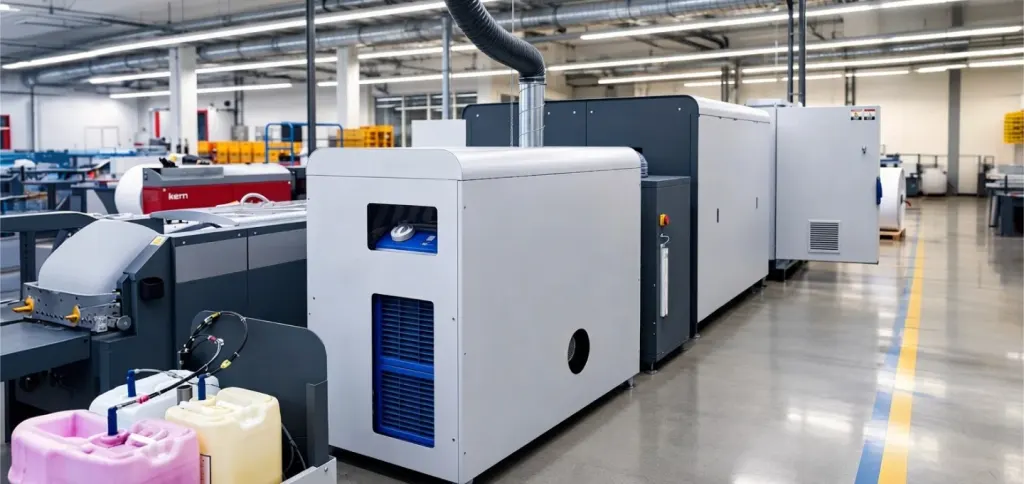
Ricoh Business Process Services in Germany faces these challenges first-hand. Supporting organisations including public administrations, local authorities, banks and insurance companies, the operation provides additional production capacity during seasonal peaks, overflow and backup requirements. Today it manages more than 110,000 print jobs a year in an environment that includes webfed inkjet and sheetfed toner production systems.
So how do you make an operation of this scale more flexible without adding complexity? Ricoh’s own experience points to 5 practical lessons.
1. Move beyond print management to workflow management
As production requirements became more complex, Ricoh Business Process Services needed to modernise its print management environment.
The challenge was not simply managing print queues. Different processes and client requirements had to be connected, new clients could require bespoke integrations, and changes to production workflows could depend on IT support. A more scalable approach means looking beyond individual print devices and managing the complete production workflow.
Ricoh Business Process Services uses RICOH ProcessDirector to provide a single point of control across its production environment. Instead of managing individual processes independently, teams can design and manage complex workflows visually and gain greater visibility across production.
Best practice takeaway: when evaluating print workflow automation, consider the complete journey of a job, not simply how efficiently work reaches a printer.
2. Standardise integrations wherever possible
Customisation can solve an immediate production requirement, but repeatedly developing one-off integrations can make an environment increasingly difficult to scale.
Using standard connectors within RICOH ProcessDirector reduces the need to build a bespoke integration for each new client. The environment supports connections with other systems and processes, including Ricoh Intelligent Data Exchange (IDX), mailing, digital archiving and electronic invoicing workflows.
The result is a more repeatable approach to bringing new requirements into the production environment.
Best practice takeaway: standardisation is not only about efficiency. Reusable connections and workflows can help remove technical barriers when onboarding new work.
3. Give production teams visibility from end to end
Complex production becomes much easier to manage when operators can see what is happening throughout the process.
RICOH ProcessDirector gives Ricoh Business Process Services end-to-end, real-time visibility across more than 110,000 print jobs a year. That visibility provides better insight into processing and production status and supports closed-loop document processing.
Integration with inserter systems also enables reprints to be automated and consolidated using business rules, helping reduce operational effort across multiple jobs.
Best practice takeaway: workflow automation should not simply move jobs faster. It should make the status of those jobs easier to understand, manage and act on.
“RICOH ProcessDirector is a highly versatile tool with many powerful features that help us improve and automate our digital and operational processes. It is easy to use; we can now visually design complex workflows quickly and manage our printing environment from a single point of control.”
Boris Jenz, Chief Manager, Technology Consultancy, Business Process Services, Ricoh Germany
4. Reduce unnecessary dependence on IT
Flexibility is particularly valuable when priorities change.
Previously, changes within the production environment could require IT intervention. With a more integrated workflow environment, operators can transfer jobs between webfed and sheetfed production devices without manual reprogramming or external IT support.
That creates more freedom to reschedule work and use available production capacity effectively. For production teams, this can be an important distinction between automation and true operational flexibility.
Best practice takeaway: look for opportunities to give operators greater control over everyday workflow decisions while maintaining consistent processes.
5. Build automation that can extend beyond print
One of the most important lessons from Ricoh’s own experience is that workflow transformation does not necessarily stop at the print engine.
The same environment already connects print production with processes including mailing, digital archiving and electronic invoicing.
Ricoh Business Process Services also plans to extend RICOH ProcessDirector workflows to support millions of document scans each year. Rather than solving an isolated production challenge, workflow technology can become a foundation for connecting a broader range of document processes.
Best practice takeaway: when designing a workflow architecture, consider not only today’s production requirements but which adjacent document processes could eventually be connected and automated.
Put these workflow principles into practice
Greater visibility, more standardised integrations, less dependence on manual intervention and the flexibility to connect processes beyond print all start with the right workflow foundation. RICOH ProcessDirector helps production teams bring these capabilities together in one environment, providing a central point of control for designing, automating and managing increasingly complex production workflows.
As an authorised RICOH partner in Romania, ROEL can help you choose and implement solutions like these. Contact ROEL.
Adapted from RICOH Europe.