What is digital textile printing and which products can you personalise?
Today, advances in technology give you easy access to production equipment for digital textile printing – a technique that lets you personalise a wide range of products, with very good working speeds and a quality of finished result that is hard to ignore.
Fine detail and strong colours printed on textiles are further benefits, which we explore below, that support the use of digital printing in business areas such as the production of personalised merchandise.
Which types of digital printing are preferred today?
There are currently two modern techniques for personalising textiles with digital printing, both offering advantages in terms of how the work is done and the results achieved in real time:
1. Digital printing techniques: digital transfer
With this type of digital printing, you can achieve high-resolution prints on a wide range of textiles: spandex, polyester, neoprene, cotton, polyurethane, PVC textiles, stretch fabrics, etc.)
1.1. Which products can be personalised using digital transfer?
1.2. How does this digital printing technique work?
The chosen design is printed on a special sheet, which is then cut along a predefined outline and applied to the chosen fabric using a heat press.
The special transfer sheet can be transparent, white or coloured, and can come in various shapes. The design is applied to it using a digital printer.
The design is cut out in a second stage using a cutting plotter, and the resulting shape is then applied to the fabric using a press at a very high temperature.
Products personalised with this digital textile printing technique can be machine washed without any problems at temperatures of up to 60°C. Garments personalised this way can also be ironed afterwards.
1.3. What are the advantages of this digital printing technique?
DTG is one of the most modern digital printing solutions, also known as "direct-to-fabric printing".
There is no minimum order quantity: you can print even a single item, however complex the chosen design.
2.1. Which products can be personalised with DTG printing?
The textile products that deliver the most spectacular results are:
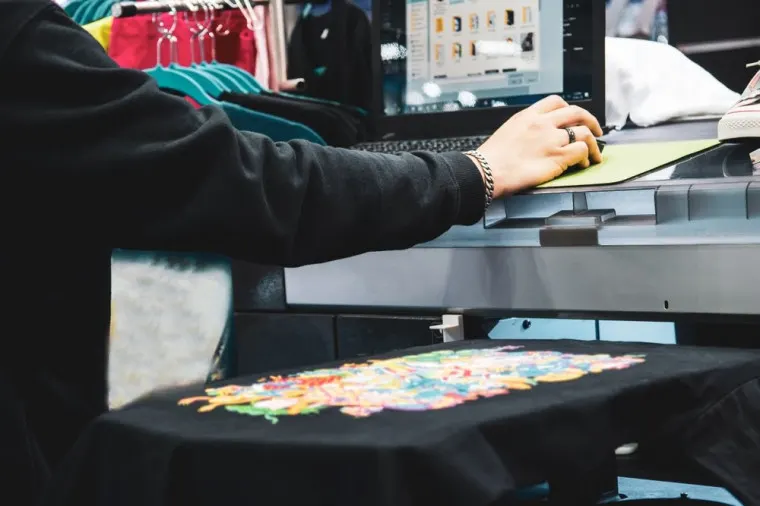
The process is similar to inkjet printing on paper, except that in DTG the ink is applied with dedicated production equipment designed specifically for printing on textiles rather than paper.
The process uses water-based, eco-friendly, flexible inks that are highly resistant to wear and repeated washing. They can easily be applied to any type of fabric.
The range of designs and colours, images and gradients allows for a very high level of creativity. It's worth noting that DTG printing on white fabric differs from printing on black or coloured fabric. Dark and coloured fabrics must first be treated with a special pre-treatment so that the base colours can adhere to the chosen fabric.
2.3. What are the advantages of this digital printing technique?
Today, advances in technology give you easy access to production equipment for digital textile printing – a technique that lets you personalise a wide range of products, with very good working speeds and a quality of finished result that is hard to ignore.
Fine detail and strong colours printed on textiles are further benefits, which we explore below, that support the use of digital printing in business areas such as the production of personalised merchandise.
Which types of digital printing are preferred today?
There are currently two modern techniques for personalising textiles with digital printing, both offering advantages in terms of how the work is done and the results achieved in real time:
- Digital transfer
- DTG (Direct To Garment) printing
1. Digital printing techniques: digital transfer
With this type of digital printing, you can achieve high-resolution prints on a wide range of textiles: spandex, polyester, neoprene, cotton, polyurethane, PVC textiles, stretch fabrics, etc.)
1.1. Which products can be personalised using digital transfer?
- hats
- jackets
- T-shirts
- umbrellas
- uniforms
- backpacks, etc.
1.2. How does this digital printing technique work?
The chosen design is printed on a special sheet, which is then cut along a predefined outline and applied to the chosen fabric using a heat press.
The special transfer sheet can be transparent, white or coloured, and can come in various shapes. The design is applied to it using a digital printer.
The design is cut out in a second stage using a cutting plotter, and the resulting shape is then applied to the fabric using a press at a very high temperature.
Products personalised with this digital textile printing technique can be machine washed without any problems at temperatures of up to 60°C. Garments personalised this way can also be ironed afterwards.
1.3. What are the advantages of this digital printing technique?
- a wide range of compatible textiles
- prints detailed designs (up to 10 million colours)
- a fast process and high durability
DTG is one of the most modern digital printing solutions, also known as "direct-to-fabric printing".
There is no minimum order quantity: you can print even a single item, however complex the chosen design.
2.1. Which products can be personalised with DTG printing?
The textile products that deliver the most spectacular results are:
- 100% cotton products
- 50% cotton, 50% polyester products
- Lycra products
- viscose products
- wool products
- microfibre products
The process is similar to inkjet printing on paper, except that in DTG the ink is applied with dedicated production equipment designed specifically for printing on textiles rather than paper.
The process uses water-based, eco-friendly, flexible inks that are highly resistant to wear and repeated washing. They can easily be applied to any type of fabric.
The range of designs and colours, images and gradients allows for a very high level of creativity. It's worth noting that DTG printing on white fabric differs from printing on black or coloured fabric. Dark and coloured fabrics must first be treated with a special pre-treatment so that the base colours can adhere to the chosen fabric.
2.3. What are the advantages of this digital printing technique?
- varied designs in millions of colours, printed on different textiles
- a pleasant feel to the touch, as the colours penetrate the fabric
- a technique that enables fast personalisation
- the option to print even on buttons or zips.