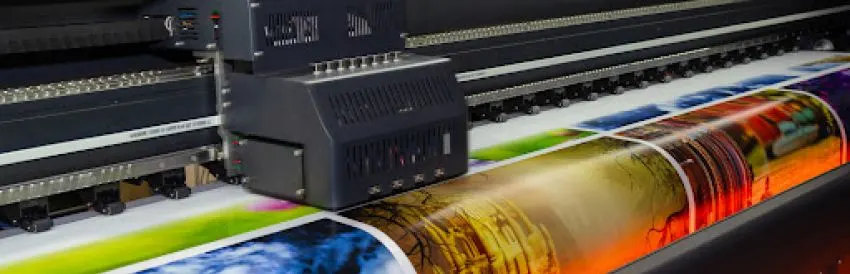
Different jobs call for different printing equipment. Above all, though, a high-quality printing press should meet all the needs of a company in this industry.
To print catalogues, brochures, posters or even books, businesses have to choose between digital and offset printers. These are two common printing methods, and both come with advantages and disadvantages.
If you want to improve your company's printing processes, read on to find out which solution suits you: digital or offset printing?
What is digital printing?
Digital printing is a newer form of printing that uses either inkjet or laser technology. Digital printing has become very affordable today and is far more widely used than offset – in fact, there's a good chance you have a digital desktop printer at home.
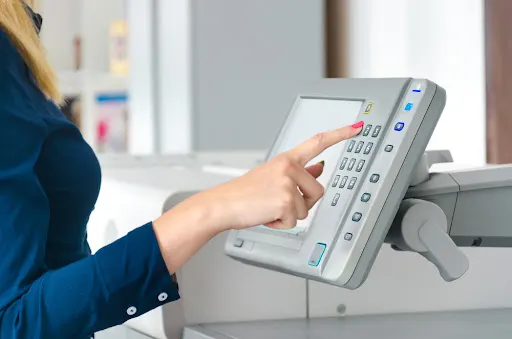
However, the digital printers used in business offices have additional features and can be larger than a printer used for personal purposes. They are usually called multifunction printers and can carry out a range of tasks depending on your business processes.
As mentioned above, there are two types of digital printers: laser and inkjet. Inkjet printers use very small droplets of ink to create the final output on paper. Laser printers work in a slightly more complex way. They have a built-in laser that projects the image onto a drum. The image then attracts toner particles, which are fused to the paper at a high temperature.
Besides a printer, your business may also need other office equipment.
What is offset printing?
Offset printing is a traditional printing method that is popular for large orders of printed items. It is an older method than digital printing.
An offset press is a large machine that uses custom plates to print each page required. Offset printing produces beautiful, high-quality results that digital printing cannot always match.
Differences between digital and offset printing
While both printing methods can be very effective depending on the job, there are some key differences between them that will lead you to choose one over the other.
These are the aspects we will compare:
Quality
Offset printers generally produce much sharper, higher-quality images with more accurate colours.
Offset presses can offer certain colour capabilities that are superior to digital printing. For example, Pantone colour printing is more accurate on offset devices because they actually use Pantone ink. This is a key factor for large corporate brands, for which colour consistency is essential.
That said, there are also many recently produced digital printers that deliver high-quality print results.
Costs
Digital printers respond to orders much faster and complete jobs in a fraction of the time thanks to significantly shorter set-up times. This is particularly true of Ricoh printers.
Businesses offering digital print services can deliver products the same day or the next day, depending on the print volume. This makes digital printing cheaper and more efficient than offset printing.
Offset printers, on the other hand, are more expensive to buy in the first place and time-consuming because of the set-up they require – so they remain costly to run as well. However, they can be cost-effective for large print volumes.
Printed sheet sizes
Digital printing usually requires a smaller sheet size, of around 48 centimetres. In some cases (though less often), the sheet size may be around 58 centimetres.
Offset presses, on the other hand, can handle sheet sizes of between 58 and 100 centimetres. This makes them ideal for print jobs that need large sheets, such as posters.
For larger sizes, industrial printers are used.
Which solution is right for your business?
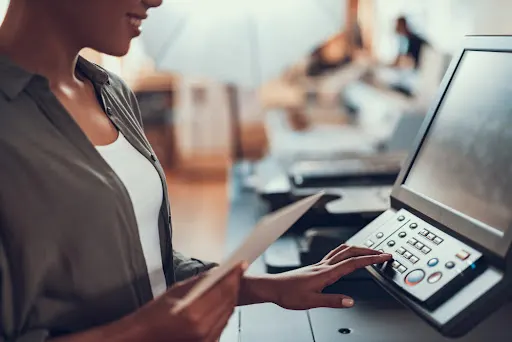
To choose the device you will use in your company, consider the following:
Available time
If your business is fast-paced and you don't have much time, digital printers will help you get the job done very quickly. Offset printers take longer to produce the final result because set-up is more complex – you have to create custom plates.
Workload
If you only print a few jobs a day or a week, a digital printer is an efficient option. If your team runs very large projects, however, you may need an offset printer.
In some cases, depending on your industry, you may need to invest in both types of printing equipment.
Print media
Offset printers work on a wide variety of materials, while digital printing can only be done on certain types of paper.
Samples
If you need to print several samples to decide on the final product or to show your clients, digital printers can be a much faster and more affordable option.
Once you've decided on a type of printer for your business, the research doesn't stop there! The next step is to choose between the different printer models within that type. But don't worry! We've written an article on how to choose the right printer for your needs.